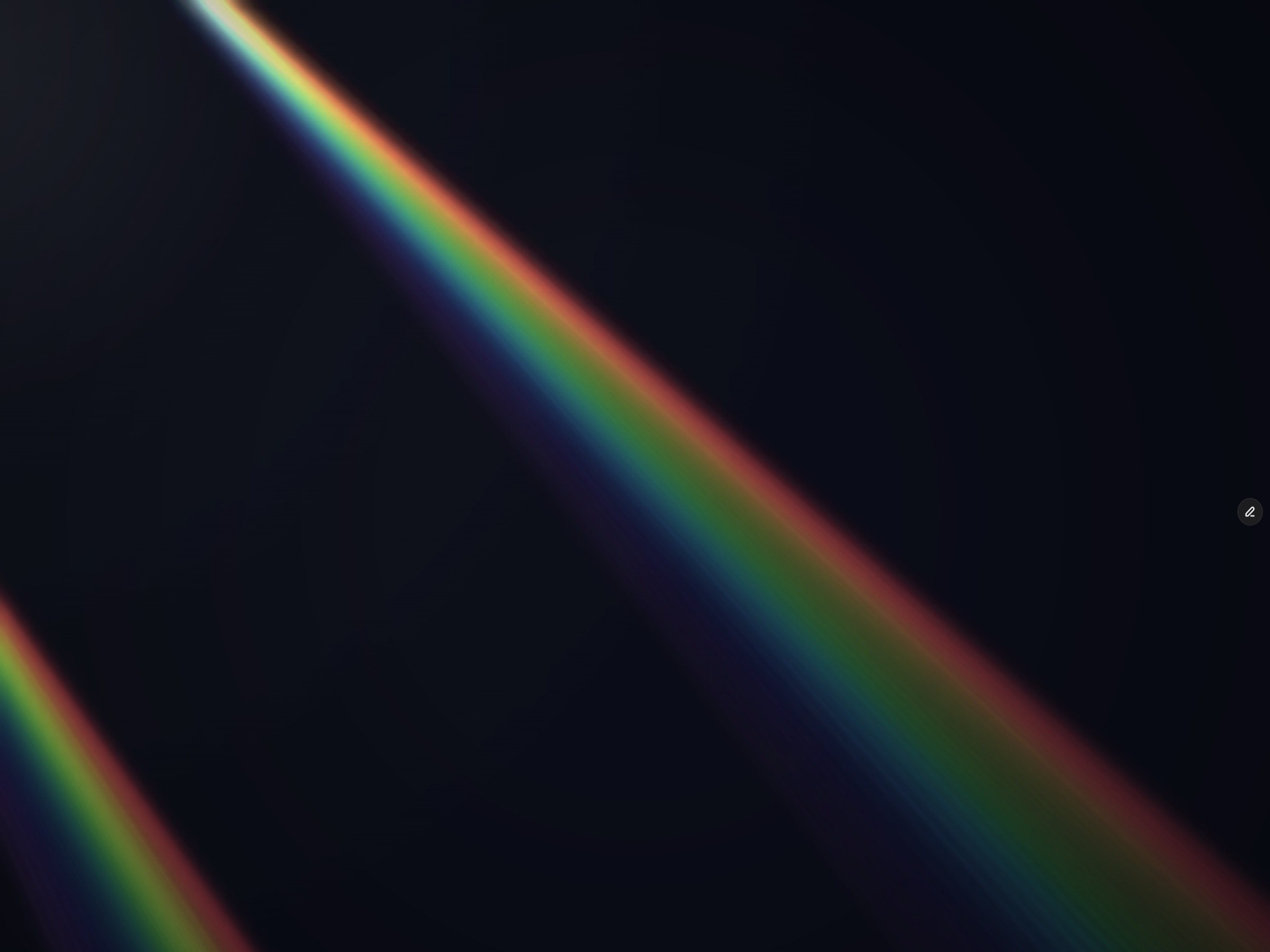
A beam of white light fanning into a full spectrum. Thirty wavelengths are sampled from 400 to 700 nm, and the glass index for each comes from Cauchy's law - so the fan is compressed in the reds and stretched in the violets on its own. The dispersion is progressive because it is computed, not painted.
Bands keep a constant width while their separation grows with distance. Near the apex they all overlap and sum to white; they only separate further out. That is what makes it read as optics instead of a rainbow gradient.
Angle, dispersion, band width, purity and a slow sweep are yours, and a soft bloom keeps it from looking like neon stripes.
One caveat, stated plainly: the effect is additive, so it needs a dark background. Physically correct dispersion on white paper is not reproducible with canvas blending.
Nothing loaded from outside. Honours prefers-reduced-motion and freezes on the Framer canvas.

A beam of white light fanning into a full spectrum. Thirty wavelengths are sampled from 400 to 700 nm, and the glass index for each comes from Cauchy's law - so the fan is compressed in the reds and stretched in the violets on its own. The dispersion is progressive because it is computed, not painted.
Bands keep a constant width while their separation grows with distance. Near the apex they all overlap and sum to white; they only separate further out. That is what makes it read as optics instead of a rainbow gradient.
Angle, dispersion, band width, purity and a slow sweep are yours, and a soft bloom keeps it from looking like neon stripes.
One caveat, stated plainly: the effect is additive, so it needs a dark background. Physically correct dispersion on white paper is not reproducible with canvas blending.
Nothing loaded from outside. Honours prefers-reduced-motion and freezes on the Framer canvas.