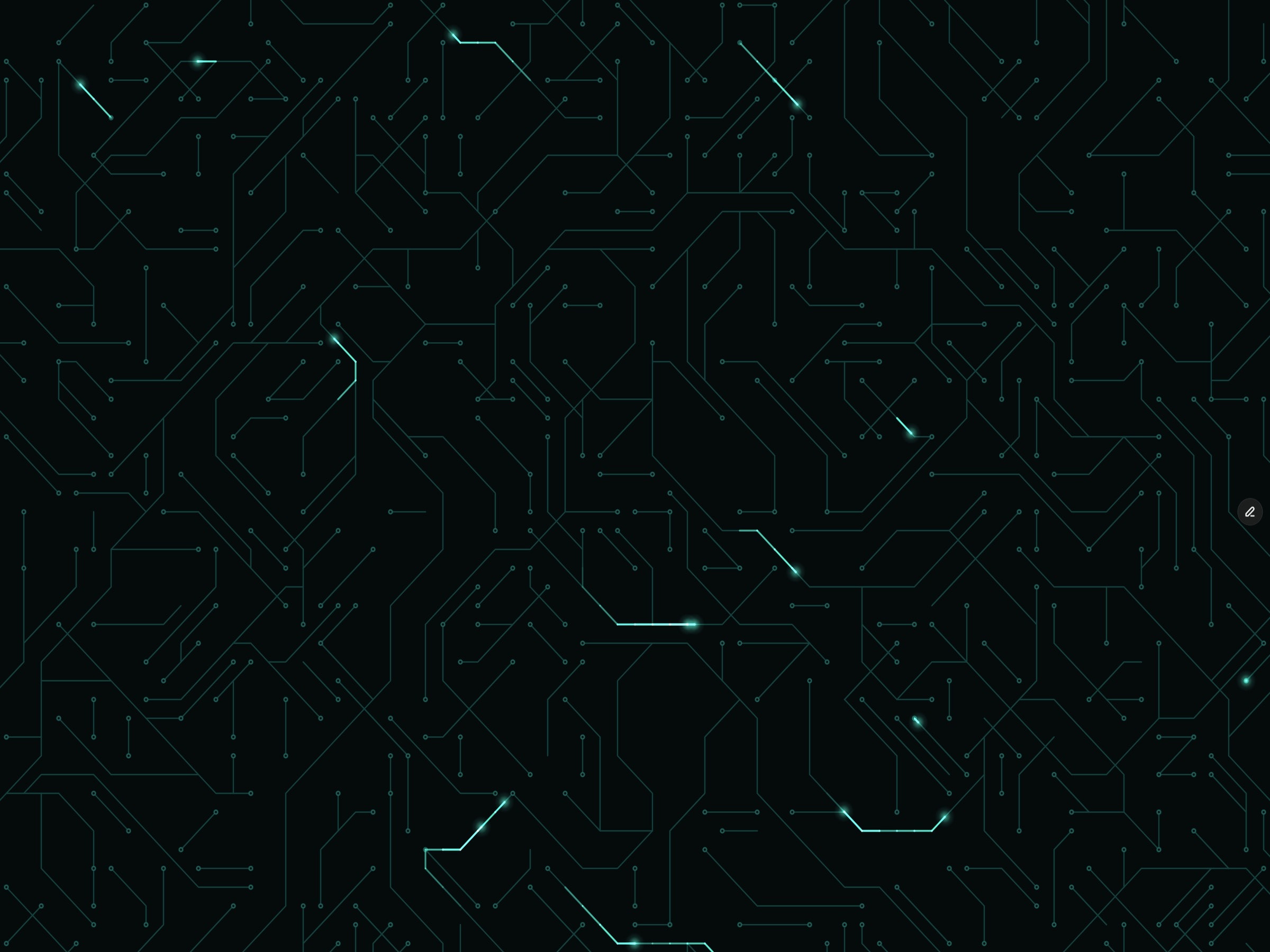
A printed circuit board where pulses of light travel the copper. The routing is real: a walk on a square lattice limited to eight directions, so every corner is a true 45 degrees; occupancy stops traces from crossing; pads are drilled discs at the ends; and one trace in two joins an existing one, which creates junctions.
That makes the network a graph, and the pulses travel it edge by edge, drawing a new branch at each node without doubling back. They genuinely change tracks, and their tails follow the corners instead of sliding over them.
The board is baked once into an offscreen layer, so the loop only copies it and paints the comets - a dense network costs the same as a sparse one.
Trace pitch, density, colours, pulse count, speed, trail length and glow are all yours, and a seed lets you keep a layout you like. Canvas, nothing loaded from outside. Honours prefers-reduced-motion and freezes on the Framer canvas.

A printed circuit board where pulses of light travel the copper. The routing is real: a walk on a square lattice limited to eight directions, so every corner is a true 45 degrees; occupancy stops traces from crossing; pads are drilled discs at the ends; and one trace in two joins an existing one, which creates junctions.
That makes the network a graph, and the pulses travel it edge by edge, drawing a new branch at each node without doubling back. They genuinely change tracks, and their tails follow the corners instead of sliding over them.
The board is baked once into an offscreen layer, so the loop only copies it and paints the comets - a dense network costs the same as a sparse one.
Trace pitch, density, colours, pulse count, speed, trail length and glow are all yours, and a seed lets you keep a layout you like. Canvas, nothing loaded from outside. Honours prefers-reduced-motion and freezes on the Framer canvas.