Framer SEO Course
This Framer SEO Course explains how to rank your Framer site first on Google, as well as getting it to be mentioned/recommended by LLMs like ChatGPT and other AI search engines.
Framer SEO Course for Beginners (Full Tutorial Guide for 2026)
A complete Framer SEO course covering both classic Google rankings and AI search — so you can rank your Framer site on Google and get cited by LLMs like ChatGPT, Perplexity, Claude, and Gemini.
Watch the Course
The Two Games You're Playing in 2026
Framer SEO today means playing two games at once:
Classic search — Google returns a ranked list, and you fight for a top spot.
AI search (GEO/AEO) — LLMs like ChatGPT and Perplexity act as a funnel, pulling information from sources and citing specific brands in their answers.
Here's the key stat worth knowing: roughly one-third of brands cited by LLMs don't rank in the top results on Google for the same query. That means Google rankings aren't the only path to AI visibility — but the remaining two-thirds of citations do correlate with Google rankings. Do classic SEO well and you'll naturally earn AI mentions too.
Keyword Research: Intent Beats Volume
Every Framer SEO strategy starts with picking the right keywords. New SEOs default to the highest search volume — that's a mistake. Weigh buying intent, not just traffic.
Example: an iPhone repair shop.
"How to repair an iPhone" — 10,000 searches/month, but people want to DIY
"Where to repair an iPhone" — 1,000 searches/month, but people want to pay someone
The second keyword converts far better despite the lower volume. Plot your keywords on a 2×2 matrix — buying intent on the y-axis, traffic on the x-axis — and prioritize the high-intent quadrants first. Use the free Google Keyword Planner for volume data.
Reverse-Engineer What Already Ranks
Don't guess at content format — Google and LLMs literally tell you what they want.
Search your target keyword on Google and look at what dominates. "How to tie a tie" → short-form videos. "Best dog food" → listicles. If listicles are ranking, write a listicle.
Run your target prompt through ChatGPT and check which sources get cited. These are both your format template and your backlink targets.
If the top result is a 2,000-word guide with images and an FAQ, publishing a 400-word blog post won't cut it.
Technical SEO for Framer Sites
You can write the best content on the internet and still lose to a slow, poorly-tagged page. The fundamentals:
Meta titles and descriptions — frontload the keyword, add intent modifiers ("24/7," "free," "affordable," location names), stay within character limits so they don't get truncated in search results.
One H1 per page. Multiple H1s confuse Google about what the page is about.
Alt text on every image for accessibility and image search rankings.
Schema markup — FAQ, article, and aggregate rating schema give you rich results (star ratings, FAQ dropdowns) that dramatically boost click-through rate. Grab templates from schema.org.
Site speed — run your domain through Google PageSpeed Insights. Slow sites lose traffic even when they rank.
Internal linking — link related pages to each other so authority flows through your site.
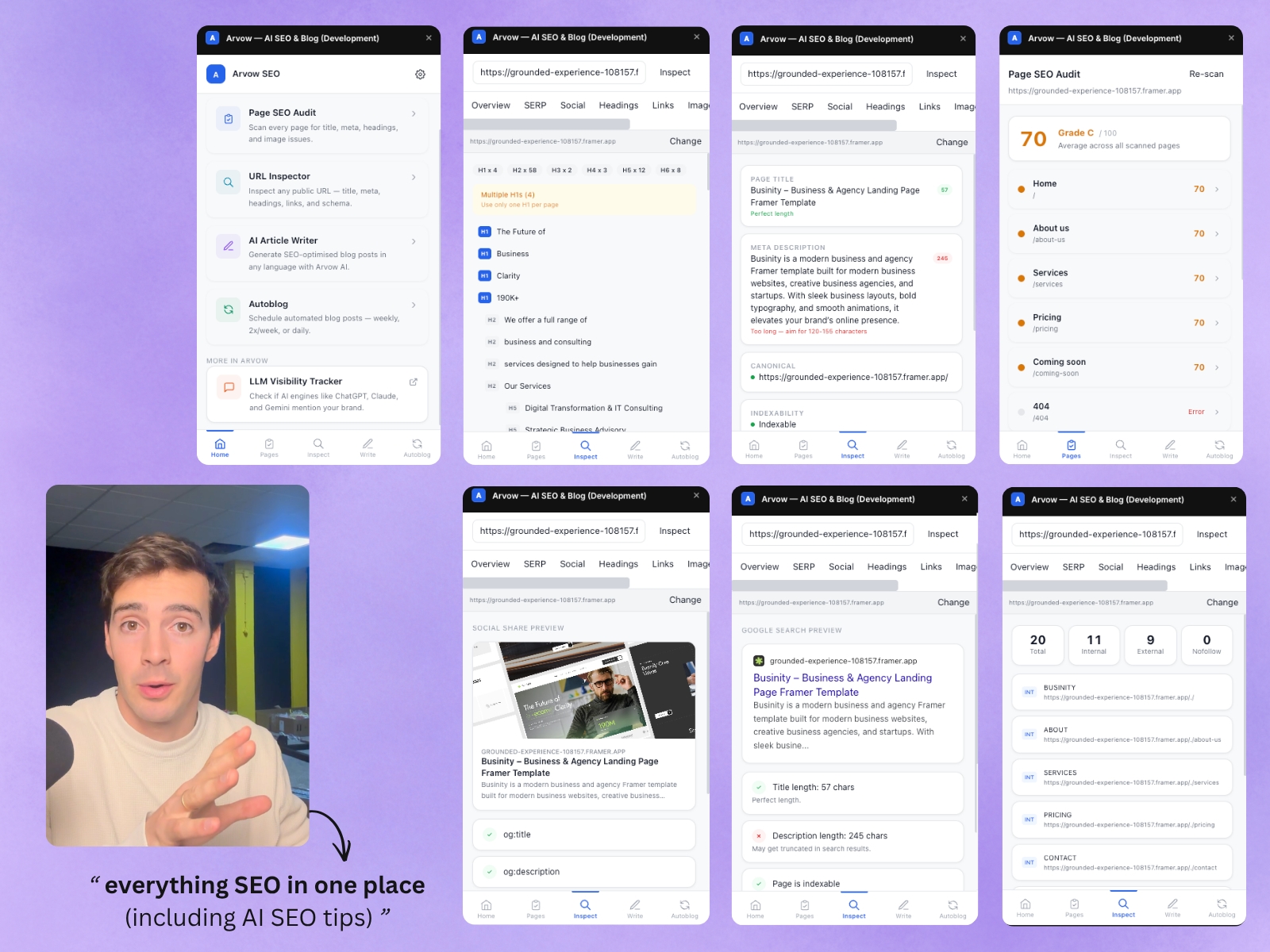
If you don't want to audit every page by hand, Arvow's AI SEO Agent scans your Framer site, flags issues, and applies fixes in bulk. The Arvow Framer plugin runs the whole audit inside Framer itself.
On-Page: What a Ranking Framer Blog Post Looks Like
For every target keyword, publish a page that matches the winning format, satisfies intent better than the current top result, and includes:
Keyword-targeted H1 and clear H2/H3 structure
Table of contents for long posts
Images with alt text, internal links, external links to credible sources
Embedded video where relevant (boosts dwell time)
FAQ section for schema + long-tail keyword capture
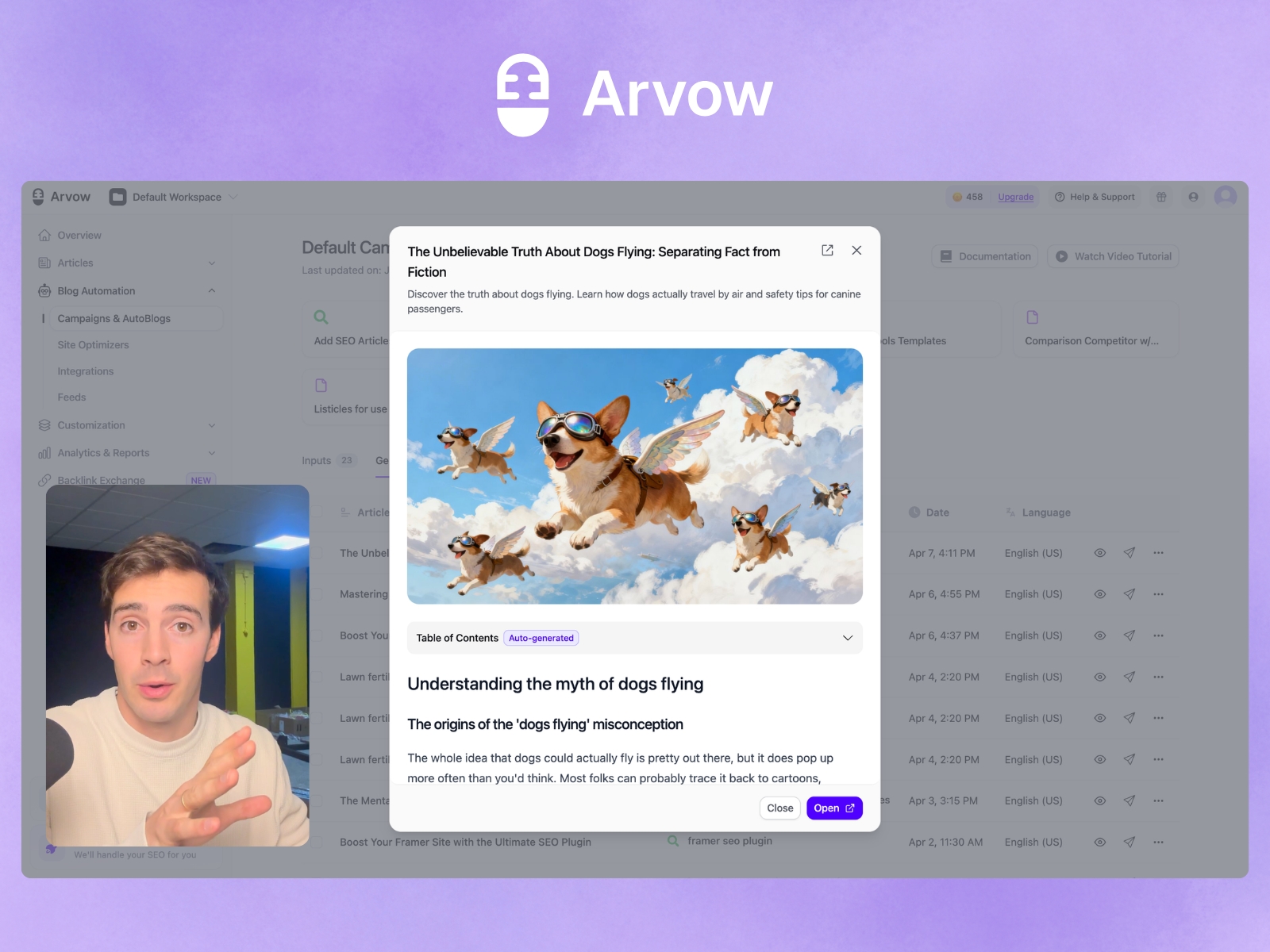
You can write this manually, with ChatGPT, or with a dedicated tool like Arvow's AI Article Writer, which generates SEO-optimized posts with images and links built in. If you're repurposing YouTube content, the Video to Blog Post feature converts transcripts directly into ranking articles.
The Two-in-One LLM Backlink Strategy
One of the highest-leverage backlink plays in 2026:
Go to ChatGPT (or any LLM) and type your target prompt — e.g., "What's the best AI SEO software for agencies?"
Open the cited sources in the response. These are usually listicle blog posts like "Top 10 AI SEO Tools for Agencies in 2026."
Reach out to the authors. Pitch a guest post, offer a sponsored placement, or ask to be added to the list.
When your brand appears in one of those cited sources, you get two wins at once: a relevant backlink from an authoritative site, and a direct line into what LLMs cite for your target prompt. The next time anyone asks ChatGPT that question, your brand has a real shot at showing up.
Tracking Your Results
If you're not tracking, you're guessing. You need visibility on two fronts:
Classic rankings via Google Search Console (free)
LLM mentions via a tool like Arvow's AI Visibility Tracker, which monitors mentions across ChatGPT, Claude, Gemini, Perplexity, and Grok
Track which prompts trigger your brand, which sources are being cited, and how sentiment trends over time.
The 6-Step Framer SEO Action Plan
List your target keywords and plot them on the intent × traffic matrix.
Analyze the top-ranking content for each keyword and match the format.
Fix your technical SEO — meta tags, site speed, schema, H1s, alt text, internal links.
Publish optimized content for your highest-intent keywords first.
Build backlinks using the LLM-source strategy.
Track rankings and AI mentions weekly. Adjust. Keep shipping.
Details
 Vasco Monteiro